
Moving companies get leads from five main sources — organic search and local SEO, referrals and word of mouth, paid ads (PPC), lead-provider marketplaces, and offline channels like branded trucks and partnerships — plus a newer one in 2026: getting cited by AI search tools like ChatGPT. But generating leads is only half the job. The companies that book the most moves are the ones that respond within minutes, follow up more than once, qualify before quoting, and track every lead through to a closed job.
Moving companies get leads from five main sources: organic search and local SEO, referrals and word of mouth, paid ads (PPC), lead-provider marketplaces, and offline/local channels like branded trucks and partnerships. Generating those leads is only half the job — the companies that actually book the work are the ones that respond fast and track every lead through to a closed move. This guide covers both halves: where moving leads come from, and how to manage them so fewer slip away.
Even though it looks like finding moving leads is easy, it is more complicated than it seems. Finding quality leads is what matters most. While many sources are available, you only want to spend energy and resources on the most efficient ones — and organizing your business for a constant stream of customers requires careful planning and effective systems behind it.
Why lead management matters for movers
Every moving business needs a lead strategy. Without one, you are relying on luck — and that is no way to run a company in an industry where customers want the best and shop around. You need to establish a presence so people can find you, most often through search. A good lead-management system also helps slow customer churn: when bookings dip, a healthy pipeline of new leads compensates while you fix the underlying issue.
Moving lead sources at a glance
Start here. This table compares every major source so you can decide where to spend first. Quality and cost vary widely by market — treat the ranges as a planning starting point, not a guarantee.
| Source | Typical cost | Lead quality | Speed to first lead | Close rate | Best for |
|---|---|---|---|---|---|
| Organic / SEO | Time + content | High | Slow (months) | High | Long-term, lowest cost per lead |
| AI search / GEO | Time + content | High | Slow (1–2 mo) | High* | “Best movers in…” AI answers |
| Local SEO / Google Business | Low | High | Medium | High | Local & “near me” searches |
| Referrals / word of mouth | Very low | Highest | Variable | Highest | Repeat-heavy, service-driven movers |
| PPC (Google / Meta) | Medium–High | Medium | Fast (days) | Medium | Filling gaps, off-season volume |
| Lead providers / marketplaces | Pay per lead | Low–Medium | Fast | ~3% (shared)* | Quick jobs, slow periods only |
| Truck & offline branding | Low (one-time) | Medium | Slow | Medium | Local brand recognition |
| Partnerships (realtors / storage) | Low (revenue share) | High | Medium | High | Steady local referral flow |
*Marketplace leads are sold to multiple movers at once; the ~3% close rate reflects that shared competition. AI-search close rate is based on early adopter reports, not hard data. Verify ranges against your own numbers.
Where do moving leads come from?
We mentioned how there are many lead sources at your disposal. Let’s see what they are and how they are different from one another.
Pay-Per-Click leads
PPC works well if you have budget to invest. You buy ads on Google, Meta, Yelp and similar platforms and pay per click. It brings results fast, but it is a double-edged sword: you have to optimize ads, track performance, and adjust weekly. There are ways a CRM boosts PPC campaigns for movers, but know your math first — if you spend more than you earn back, you are wasting money. Calculate a budget, track performance, scale what works, and re-evaluate what underperforms.
Third-Party leads
These come from companies that sell the same inquiry to several movers at once. Competition is fierce and the close rate is low (around 3%), so your team has to respond quickly and be fully transparent to win. It is useful for a quick job or filling an off-season gap, but it is a poor long-term foundation — don’t build your business on bought leads.
Organic leads
Organic leads are the best but the hardest to earn: a customer finds you naturally through research, with no per-lead cost. They come from a quality SEO strategy, software that helps you track customer satisfaction, attending local events, networking on social media, and recommendations from past customers. Of the three lead types, organic ranks first, PPC second, and bought marketplace leads last.
Local and offline lead sources
Online isn’t the only channel. These local tactics are especially effective for movers who are just starting out:
- Branded moving trucks — a clean logo and contact info on every truck is rolling local advertising. Too much text is as bad as none.
- Realtor partnerships — set up a two-way referral deal with reputable local agents; you send each other customers.
- Storage-company partnerships — if you don’t offer storage yourself, partner with nearby facilities for mutual referrals.
- Community involvement — offer services for charity events and local programs in exchange for visibility and promotion.
- Ask past customers — satisfied clients refer others; make it easy and give a clear, value-based reason to do so.
AI search (getting cited by ChatGPT, Perplexity & Gemini)
When a customer asks an AI assistant “who are the best movers in Denver?” or “how do I choose a moving company?”, you want your company named in the answer. Getting cited this way is called Generative Engine Optimization (GEO), and it behaves like organic search: slow to build, low cost, high-quality leads once it lands.
Why it matters now: AI assistants already handle a rapidly growing share of informational searches, and the sources they cite increasingly differ from Google’s top results — so ranking #1 on Google no longer guarantees you appear in the AI answer. Treat GEO as a separate channel, not a byproduct of SEO.
How movers earn AI citations:
- Submit your sitemap to Bing Webmaster Tools — ChatGPT’s web search uses Bing’s index, so this makes you eligible to be cited.
- Strengthen off-site signals AI trusts: reviews, Reddit/Quora presence, and third-party mentions, which AI answers lean on heavily for local services.
- Write answer-first content with clear stats, named authors, and visible dates (the same on-page work that makes this guide citable).
- Keep your Google Business Profile, name/address/phone, and service areas consistent everywhere — AI pulls local facts from structured, consistent sources.
- Be patient: expect roughly a 4–8 week lag between publishing and showing up in AI answers.
Improve your SEO
Keyword research is the foundation. Study the top movers in your area, see which terms they target, and build better versions — start local before expanding. Turn that list into articles and social posts, keep URLs short and meaningful, use proper image and video attributes, and link internally across your site.
Local events are suitable for promotions. Local SEO and presence at community events build visibility with the people most likely to hire you. Social media spreads awareness and amplifies your blog — connecting social media with your CRM keeps you a step ahead. And the strongest channel of all is word of mouth — satisfied customers refer friends and family, so consistently collecting reviews from customers protects your reputation and feeds future leads.
How to qualify a moving lead
Not every lead deserves the same effort. Qualifying means scoring each inquiry on a few signals, then routing your time to the leads most likely to book. A simple model:
| Signal | What to look for | Weight |
|---|---|---|
| Move date | Sooner = hotter; within 2–4 weeks is high intent | High |
| Move type / distance | Matches your core service and margins | High |
| Source | Organic & referral outrank shared marketplace leads | Medium |
| Budget signal | Asked about price, scope, or add-on services | Medium |
| Responsiveness | Replies quickly, provides details | Medium |
Tier the result: hot leads get an immediate call and same-day quote; warm leads enter a follow-up sequence; cold or out-of-scope leads get a quick automated reply so no one is left hanging.
The first-response window
The single biggest factor in converting a moving lead isn’t the source — it’s how fast you respond. The landmark Harvard Business Review / MIT lead-response research (15,000+ leads across 100+ companies) found that leads contacted within 5 minutes were about 21 times more likely to be qualified than those contacted after 30 minutes, and that waiting just an hour cut the odds of qualifying a lead roughly sevenfold. Yet most companies respond far too slowly to capture that advantage.
| Response time | Effect on qualifying the lead | What it signals to the customer |
|---|---|---|
| Within 5 minutes | Best — baseline odds | Responsive, professional, ready to help |
| Within 30 minutes | ~21x less likely to qualify | Reliable, but a faster mover may beat you |
| Within 1 hour | ~7x less likely than 1 hour earlier | Acceptable, momentum fading |
| Next day or later | Drastically lower | Likely already booked elsewhere |
Figures from the Harvard Business Review / MIT (Oldroyd) lead-response research.
Managing leads after they come in
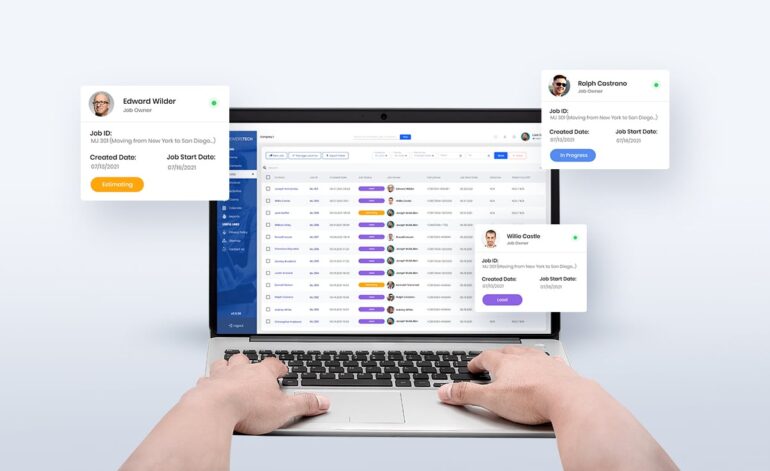
Once a lead arrives, it moves through a predictable pipeline. A moving CRM keeps every step in one place so nothing falls through:
- Capture leads from web forms, marketplaces, calls, and social all land in one pipeline automatically, so none are re-typed or lost.
- Auto-assign each lead routes to the right rep by source or territory the moment it arrives, enabling fast follow-up.
- Follow-up — automated reminders and sequences keep every lead engaged and help you build trust with leads, instead of relying on memory or a sticky note.
- Track every interaction and status is logged (and internal communication stays connected), so you can see which leads are engaged and ready to convert (lead scoring).
- Report pipeline analytics show which sources actually produce booked jobs, so you can shift spend to what works.
Working with lead providers
If you do use marketplaces, choose providers on lead quality, volume, pricing, and reputation, and check customer reviews before committing. Set clear expectations in a simple service-level agreement, communicate regularly, and review performance metrics. Pipe provider leads straight into your CRM so they’re assigned and followed up instantly — speed is the only way to win shared leads. Condensed from three near-identical sections in the current article.
A simple lead workflow you can start this week
If you’re just getting organized, you don’t need a complex system. Start here:
- Create one intake form and point every channel (website, ads, social) to it.
- Define five pipeline stages: New → Contacted → Quoted → Booked → Lost.
- Write three follow-up email templates: instant reply, day-2 nudge, day-5 check-in.
- Set a response-time rule (SLA): first contact within 5–15 minutes during business hours.
- Review source ROI once a month and move budget toward what books jobs.
Mistakes that waste moving leads
Most lost leads aren’t a generation problem — they’re a follow-through problem. The usual culprits:
- Slow first response — the lead books with whoever called back first.
- One-and-done outreach — giving up after a single attempt.
- No source tracking — you can’t cut what you can’t measure.
- Manual estimates — delays that let faster competitors win.
Turn your leads into booked moves
Generating leads is only half the work. The companies that win are the ones that respond fast, follow up consistently, and track every lead from first inquiry to booked job — without anything slipping through the cracks.
That’s what MoversTech CRM is built for: capture every lead in one pipeline, automate the follow-up, and see exactly which sources turn into revenue.
Book a demo to see it run on your own workflow.
Frequently Asked Questions
What are the best sources of moving service leads?

The best moving service leads come from organic search, local SEO, social media, referrals, and well-managed PPC campaigns. Using moving software to track and organize these leads helps ensure high-quality prospects don’t get overlooked.
How do moving companies get consistent leads?
A steady flow of leads for moving companies comes from combining SEO, ads, reviews, and networking with strong follow-up systems. Moving CRM software helps automate reminders, track conversations, and manage every lead from first inquiry to booked job.
Are moving lead providers worth using?
Moving lead providers can be helpful during slow periods, but conversion rates are low and competition is high. Integrating provider leads into moving CRM software ensures fast response times, better tracking, and higher close rates compared to managing leads manually.
How can movers get more local moving leads?
Movers can grow local moving leads through local SEO, reputation building, community engagement, and targeted online ads. Moving software supports this by capturing leads automatically, tracking their source, and helping teams respond quickly with accurate quotes.
What’s the difference between lead generation and lead management?
Lead generation is attracting new inquiries; lead management is what happens after they arrive — qualifying, following up, tracking, and converting them. Most revenue is won or lost in management, not generation.
Reviewed by: Ned Bjelos
